It’s half past nine on a Tuesday and you’re still doing the invoicing.
Get your evenings back
Most small businesses reach a point where the paperwork outgrows the owner. The usual answer is to hire someone to deal with it.
I build the system that deals with it instead — so when you do take someone on, it’s someone who moves the business forward.

Which one is you?
- “I’m still doing the invoicing at half nine at night.”
- “There must be a simpler way of doing this.”
- “My staff spend half their week filling in forms.”
- “We’re paying for six different apps and none of them talk to each other.”
- “The same job gets written down four times before it’s invoiced.”
- “Sooner or later I’m going to miss an enquiry.”
- “If I was off for a month, nobody would know how any of this works.”
- “I’m about to take someone on just to keep up with the paperwork.”
What I do
You already have a way of doing things.
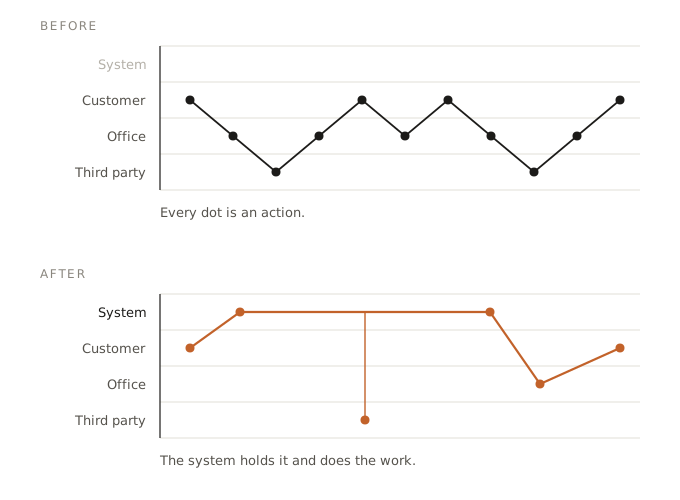
It works, mostly. It lives in a diary, a spreadsheet, a pile of paper and your own head. The trouble is it only works because you’re holding it together.
I start with the work itself: how you actually run your business day to day — from how the customer makes contact, to what you do and who you deal with, to how you bill and report. I chat to you about what’s working and what’s taking too much time.
I look for where you’re duplicating work and where things can be simpler — customers contacting you by social media, email and text, all funnelled into one place for you to pick up. Where you can cut down the number of spreadsheets, apps and administration tools you’re keeping going. And how you can be confident that everything is being managed.
Then I build it, show you how to run it, write it down, and hand it over.
I don’t build accounting systems. You keep Sage, QuickBooks, Xero or whatever your accountant has you on — I make sure the figures land there without anyone typing them in twice.
You own it outright. There’s a monthly cost for the software it runs on, paid direct to them — I’ll tell you exactly what that is before we start — but there’s nothing ongoing to me.
Customer testimonials
Oliver’s Highland Pet Crematorium
Oliver’s is an independent pet crematorium on the Black Isle — collections across the Highlands, individual cremations, keepsakes, and families coming in person to say goodbye. Nine months in, it ran on a paper diary, whiteboards round the steading and one very long spreadsheet, and Lisa was about to advertise for an office administrator to keep up with it.
These are her words, not mine.
What evening? I genuinely didn’t have one! I had no real downtime at all. I was working from around 8.30 or 9 in the morning until 9.30 or 10 at night most days, and I was exhausted.
For somebody to come into that business and, within the space of two or three hours, really understand how it operated, how all the different parts fitted together and where the weaknesses were was pretty impressive.
I would estimate it’s saving me around two hours a day simply by removing so much of the duplication. That’s around 10 hours a week — 40 hours a month. Effectively an entire working week every month that I’ve got back.
People contact Oliver’s in just about every way imaginable — Facebook, Instagram, WhatsApp, text, website enquiries, several email addresses, landline and mobile. As the business became busier, I had a genuine fear that eventually I was going to miss something.
Jen recognised that and created a way of funnelling those enquiries into Airtable, where new enquiries are filtered separately for us to deal with. She also created a separate link for our veterinary practices so that their information comes directly into the system before a pet even arrives with us.
That has taken away a huge amount of stress. Jen hasn’t just given me time back; she’s given me peace of mind too.
One thing I really liked was that Jen didn’t simply build the system, hand it over and disappear. She came back and spent time within the business while we actually used it. We worked through it in stages, tested it operationally and tweaked things as we went.
She’s still hiring. It’s just not the same job.
Now, because Jen has built the systems for us and they’re actually very straightforward to use, I don’t need somebody with that same level of IT expertise. That’s opened the role up to a much wider range of people.
More importantly, the role can now be much more interchangeable with mine. Rather than having one person sitting doing administration while I’m always out front, we’re looking for somebody who can learn both sides and work alongside me with families as well. Ultimately, that gives me the opportunity to have a day off too!
The business is no longer running me. I now run the business.
Lisa Lugton, Oliver’s Highland Pet Crematorium, Conon Bridge
- Around two hours a day back — ten hours a week, forty hours a month.
- Enquiries from nine different places now arrive in one list.
- Her first holiday since founding the business, with nothing to sort out while she was away.
- The vacancy changed from office administration to a role working alongside her, offering more hours than first planned.
- With the time that’s been freed up, the business is opening on Saturday mornings.
What it costs
Two hours with you, at your premises or over a video call — whichever suits you. We go through what a normal day actually looks like, where the time disappears, and what you wish the business could do. You get a written report: what’s worth fixing, in what order, and what each piece would cost. Yours to keep.
Priced as separate pieces, so you can start with the one that will bring you the most benefit, and progress through the improvements that you want at the speed that works for you. Your data is moved across, training guides and written system documentation are provided. You own all of it.
I come back, sort out any drift, find out what you’re doing with your evenings now, and we look at what’s worth doing next. Booked in on the day I hand over.
Take up any of the work within three months and the £250 comes off the first piece — so if we go ahead, the MOT costs you nothing. Fixed prices, agreed before I start. If a job turns out bigger than it looked, that’s my problem, not yours.
The things people ask
Am I too small for this?
Probably not. The usual assumption is that you need to be a bigger business before any of this is worth doing, and it is the one thing Lisa at Oliver’s said she’d most want another owner to hear is wrong.
What I build is sized to what you actually do. It is easier and cheaper to put the foundations in while you’re growing than to unpick it all once you’re overwhelmed.
What happens if I go under a bus?
This is the bit most people don’t think about until it’s too late. At the moment, how your business runs lives in your head. If you were off for six weeks, someone would have to guess.
Part of what I build is the writing-down. The system holds the way you do things, and the documentation explains it. Whoever comes next — a new member of staff, a family member, a buyer — has something to learn from instead of starting cold.
What happens if you go under a bus?
Fair question, and you should ask it of anyone who builds you something.
I don’t write custom code that only I understand. I build on well-established platforms that plenty of other people know how to work with, so you’re not dependent on me being available. Everything is documented, you hold every login, and your data can be exported at any time in a format anything else can read.
Where does my data actually live?
On servers run by the software provider, with UK and EU data protection rules applying. Backed up continuously — considerably better protected than a spreadsheet on the office computer, which is where most businesses keep everything at the moment.
If you’d rather also hold your own copy, I’ll set up a regular export onto a machine in your office so you always have one in your hands. Some people sleep better that way, and it’s no trouble.
What about GDPR?
If you hold customer names, addresses or payment details — and nearly everyone does — the rules already apply to you, whether that information sits in a system or a notebook.
A proper system usually makes this easier rather than harder: you can see who has access to what, find someone’s records when they ask, and delete them when you should. I’ll set it up sensibly and tell you what you’re responsible for. I’m not a lawyer, and for anything complicated you should take proper advice.
Am I going to end up paying for another six apps?
The opposite, usually. A lot of what I do is replacing three or four things that half-work with one that does the job. There will normally be one monthly software cost, paid direct to the provider, and I’ll tell you exactly what it is before we start.
Who you would be dealing with
I’m Jen Weston.
Eighteen years in project management, the last seven as a senior IT project manager at Tarmac, most of it spent improving the way large organisations work.
I enjoyed the corporate years. But in a company that size you deliver something and never meet the person it lands on.
I want to spend my time working with local businesses, finding out what they do, and ultimately giving people the time back to do what they love.
I’m based in the Highlands and I work with businesses across the region.
Worth a conversation?
Tell me what keeps eating your time and I’ll tell you honestly whether I can help. If I can’t, I’ll say so.
And if you’d rather hear it from a customer than from me, say so and I’ll arrange a call with one. You can ask them whatever you like.
07837 697535